
Celley 7 oz Weighted Utensils, 4 Piece Set
Weight: 7 oz per piece, item weight field 198.45 g
Best for: Adults with hand tremors who want flatware that reads as ordinary at the table
Pieces: 4: fork, knife, soup spoon, table spoon

Weighted Utensils is the research desk behind this page. Weighted utensils are ordinary forks, spoons and knives with mass added to the handle. The desk is in the midst of reviewing the most popular sets on the market. The bench protocol covers a 1 g scale reading, calipers, 10 dishwasher cycles and a soup spill count. Figures carry their source, such as the seller's listing on the date recorded.
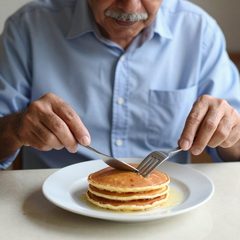
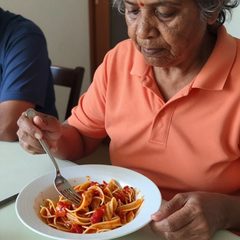
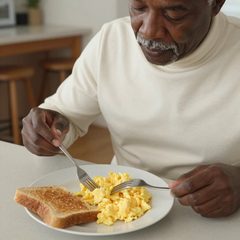
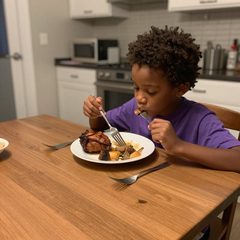
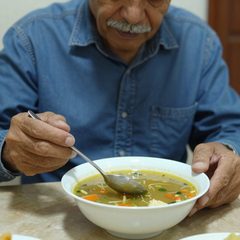

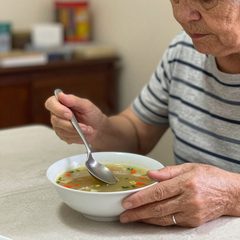
As an Amazon Associate we earn from qualifying purchases. Prices and ratings were recorded from Amazon on the date this page was last updated.
Which weight steadies a shaking hand, and when a heavy set makes fatigue worse.
By needArthritis and gripBuilt-up handles, handle diameter and the weight a weak hand can carry through a meal.
By needKids and feedingChild-sized weights for sensory, motor and self-feeding goals, with the therapist's role.
By needSeniors and careDementia, stroke and care-home mealtimes: dignity, washing, and what coverage exists.
A 7 oz weighted fork weighs 198 g, about four times the 50 g fork already in your drawer, and that multiplier is what the hand feels. Some listings state added weight and others state total weight, and roughly half the weighted listings in our pool state no weight at all. Weigh your own flatware first, then read every product page here in grams. Read the full guide
Tremor, weak grip, sensory feeding and dementia care look similar at the table and need different equipment. A shaking hand may want 7 oz of mass, a weak grip usually wants a wider handle before any weight, and a child needs a bowl sized by hand span. Each hub above opens with the measurement that decides the purchase. See the routing table
Four sources repeat 6 to 8 oz per piece as the starting band, and none of them cites a study. Below it sit built-up handles at 3.2 oz and foam grip tubing with no added mass, and above it sit 8 oz sets for tremors that 7 oz did not settle. At 8 oz a hand lifts about 9.1 kg over a 40 bite meal, so the step between bands is larger than the labels suggest. Read the full ladder
Celley publishes 7 oz per piece in a pattern that reads as ordinary flatware, and Kinsman KEatlery adds a finger indentation at about 7.2 oz. Essential Medical Supply is the 8 oz class pick for tremors that 7 oz did not settle. Special Supplies carries no added mass at all, and it is the set to buy when the problem is grip rather than shake. See every pick with price per piece
Every piece goes on a 1 g kitchen scale and under calipers for handle diameter. Balance point comes off a pencil edge, followed by 10 top rack dishwasher cycles. Spills are counted over 20 spoonfuls of the same soup, bowl to mouth height. Where a seller states a limit, such as 125 F for Sure Grip, the protocol stops there. Read the full method
A 14 day trial with one baseline meal, one week per weight and a washout day between them answers the question before the return window closes. Log three numbers per meal: spills, minutes and bites that needed help. Treat fewer than two spills of change across five meals as noise. Read the 14 day protocol
Across 67 competitor and authority pages, not one cites a named peer-reviewed trial of weighted cutlery. The 70 and 85 percent figures in circulation are manufacturer claims for the $195 Liftware Steady and the $199.99 GYENNO electronic spoons. A weighted set is a low cost, low risk trial with wide practitioner adoption and no published dose-response data. Read what the sources say
thenri.org states that weighted utensils suit mild to moderate tremors and may not help severe tremor, rigidity or late stage Parkinson's. Fatigue is the other stop signal: if the shoulder aches by minute 10, drop a class and finish the meal with a 3.2 oz built-up piece. Big-Grip and Sure Grip carry Proposition 65 warnings, and Big-Grip contains natural rubber latex. Read the contraindications